Search This Blog

Monday, 3 October 2011

Internal combustion engines

                     Early attempts at making and using internal combustion engines ere hampered by the lack of suitable fuels, particularly liquids, and the earliest engines used gas mixtures.
 In1806, Swiss engineer François Isaac de Rivaz who built an engine powered by internal combustion of a hydrogen and oxygen mixture. 
In 1826, Englishman Samuel Brown who tested his hydrogen-fuelled internal combustion engine by using it to propel a vehicle up Shooter's Hill in south-east London.Belgian-born Etienne Lenoir's Hippomobile with a hydrogen-gas-fuelled one-cylinder internal combustion engine made a test drive from Paris to Joinville-le-Pont in 1860, covering some nine kilometres in about three hours. A later version was propelled by coal gas. A Delamare-Deboutteville vehicle was patented and trialled in 1884.


About 1870, in ViennaAustria (then the Austro-Hungarian Empire), inventor Siegfried Marcus put a liquid-fuelled internal combustion engine on a simple handcart which made him the first man to propel a vehicle by means of gasoline. Today, this car is known as "the first Marcus car". In 1883, Marcus secured a German patent for a low-voltage ignition system of the magneto type; this was his only automotive patent. This design was used for all further engines, and the four-seat "second Marcus car" of 1888/89. This ignition, in conjunction with the "rotating-brush carburetor", made the second car's design very innovative.


                                    The second Marcus car of 1888 (Technical Museum Vienna)


Invention of Benz:-


Although several other German engineers (including Gottlieb DaimlerWilhelm Maybach, and Siegfried Marcus) were working on the problem at about the same time,Karl Benz generally is acknowledged as the inventor of the modern automobile.

An automobile powered by his own four-stroke cycle gasoline engine was built in Mannheim, Germany by Karl Benz in 1885, and granted a patent in January of the following year under the auspices of his major company, Benz & Cie., which was founded in 1883. It was an integral design, without the adaptation of other existing components, and included several new technological elements to create a new concept. He began to sell his production vehicles in 1888.


His first Motorwagen was built in 1885, and he was awarded the patent for its invention as of his application on January 29, 1886. Benz began promotion of the vehicle on July 3, 1886, and about 25 Benz vehicles were sold between 1888 and 1893, when his first four-wheeler was introduced along with a model intended for affordability. They also were powered with four-stroke engines of his own design. Emile Roger of France, already producing Benz engines under license, now added the Benz automobile to his line of products. Because France was more open to the early automobiles, initially more were built and sold in France through Roger than Benz sold in Germany.
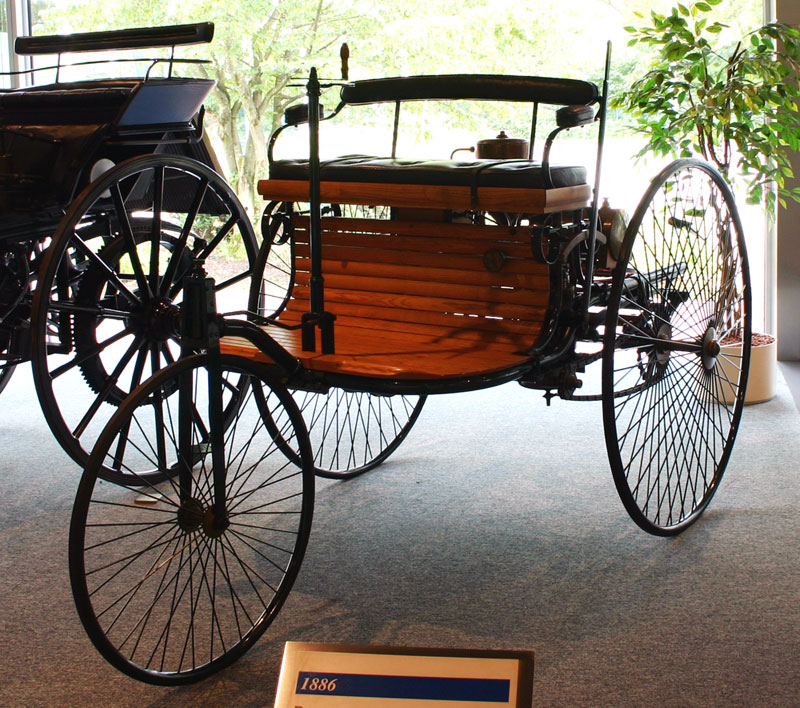
In 1879, Benz was granted a patent for his first engine, which had been designed in 1878. Many of his other inventions made the use of the internal combustion engine feasible for powering a vehicle.
1885-built Benz Patent Motorwagen, the first car to go into production with an internal combustion engine

Karl Benz, the inventor of the modern automobile
Ford domination:-


The large-scale, production-line manufacturing of affordable automobiles was debuted by Ransom Olds at his Oldsmobile factory in 1902 based on theassembly line techniques pioneered by Marc Isambard Brunel at the Portsmouth Block Mills, England in 1802. The assembly line style of mass production and interchangeable parts had been pioneered in the U.S. by Thomas Blanchard in 1821, at the Springfield Armory in Springfield, Massachusetts.This concept was greatly expanded by Henry Ford, beginning in 1914.
As a result, Ford's cars came off the line in fifteen minute intervals, much faster than previous methods, increasing productivity eightfold (requiring 12.5 man-hours before, 1 hour 33 minutes after), while using less manpower. It was so successful, paint became a bottleneck. Only Japan black would dry fast enough, forcing the company to drop the variety of colors available before 1914, until fast-drying Duco lacquer was developed in 1926. This is the source of Ford's apocryphal remark, "any color as long as it's black".In 1914, an assembly line worker could buy a Model T with four months' pay.

Portrait of Henry Ford (ca. 1919)

Ford's complex safety procedures—especially assigning each worker to a specific location instead of allowing them to roam about—dramatically reduced the rate of injury. The combination of high wages and high efficiency is called "Fordism," and was copied by most major industries. The efficiency gains from the assembly line also coincided with the economic rise of the United States
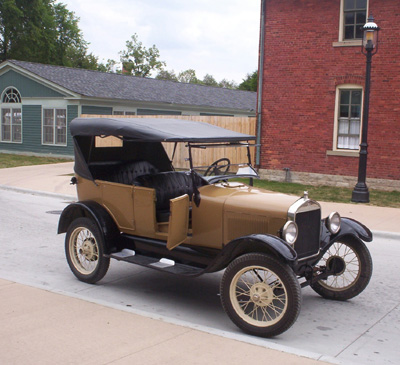


Ford Model T, 1927, regarded as the first affordable American automobile

History of Automobile

Several Italians recorded designs for wind driven vehicles. The first was Guido da Vigevano in 1335. It was a windmill type drive to gears and thus to wheels. Vaturio designed a similar vehicle which was also never built. Later Leonardo da Vinci designed a clockwork driven tricycle with tiller steering and a differential mechanism between the rear wheels
                                          the 1st design of automobile(image pic)
A Catholic priest named Father Ferdinand Verbiest has been said to have built a steam powered vehicle for the Chinese Emperor Chien Lung in about 1678. There is no information about the vehicle, only the event


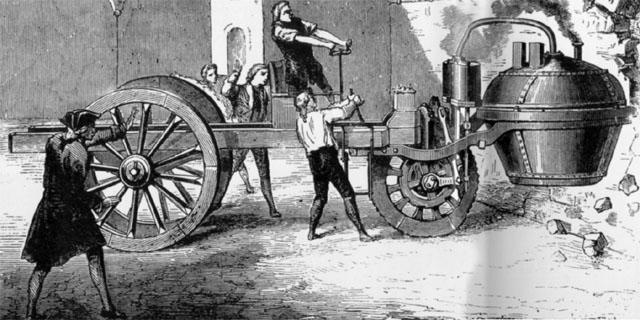
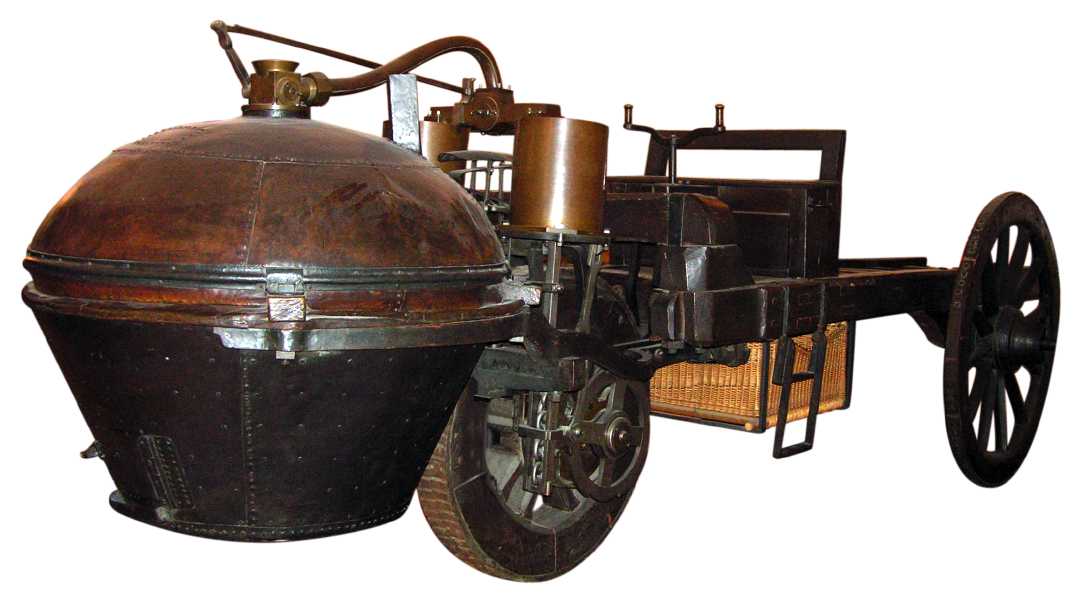
The first vehicle to move under its own power for which there is a record was designed by Nicholas Joseph Cugnot and constructed by M. Brezin in 1769. A replica of this vehicle is on display at the Conservatoire des Arts et Metiers, in Paris. I believe that the Smithsonian Museum in Washington D. C. also has a large (half size ?) scale model. A second unit was built in 1770 which weighed 8000 pounds and had a top speed on 2 miles per hour and on the cobble stone streets of Paris this was probably as fast as anyone wanted to go it. The picture shows the first model on its first drive around Paris were it hit and knocked down a stone wall. It also had a tendency to tip over frontward unless it was counterweighted with a canon in the rear. the purpose of the vehicle was to haul canons around town.
Cugnot's steam wagon, the second (1771) version
In 1801 Richard Trevithick was running a full-sized vehicle on the road in Camborne. Such vehicles were in vogue for a time, and over the next decades such innovations as hand brakes, multi-speed transmissions, and better steering developed. Some were commercially successful in providing mass transit, until a backlash against these large speedy vehicles resulted in the passage of the Locomotive Act (1865), which required self-propelled vehicles on public roads in the United Kingdom to be preceded by a man on foot waving a red flag and blowing a horn. This effectively killed road auto development in the UK for most of the rest of the 19th century; inventors and engineers shifted their efforts to improvements in railway locomotives

                                   A replica of Richard Trevithick's 1801 road locomotive 'Puffing Devil'


The four-stroke petrol (gasoline) internal combustion engine that constitutes the most prevalent form of modern automotive propulsion is a creation of Nikolaus Otto. The similar four-stroke diesel engine was invented by Rudolf Diesel. The hydrogen fuel cell, one of the technologies hailed as a replacement for gasoline as an energy source for cars, was discovered in principle by Christian Friedrich Schönbein in 1838. The battery electric car owes its beginnings to Ányos Jedlik, one of the inventors of the electric motor, and Gaston Planté, who invented the lead-acid battery in 1859


Electric automobiles

In 1828, Ányos Jedlik, a Hungarian who invented an early type of electric motor, created a tiny model car powered by his new motor. In 1834, Vermont blacksmith Thomas Davenport, the inventor of the first American DC electrical motor, installed his motor in a small model car, which he operated on a short circular electrified track. In 1835, Professor Sibrandus Stratingh of Groningen, theNetherlands and his assistant Christopher Becker created a small-scale electrical car, powered by non-rechargeable primary cells. In 1838, Scotsman Robert Davidson built an electric locomotive that attained a speed of 4 miles per hour (6 km/h). In England, a patent was granted in 1840 for the use of rail tracks as conductors of electric current, and similar American patents were issued to Lilley and Colten in 1847. Between 1832 and 1839 (the exact year is uncertain), Robert Anderson of Scotland invented the first crude electric carriage, powered by non-rechargeable primary cells
                             Electric vehicle model by Ányos Jedlik, the inventor of an early type of      
                                                          electric   motor (1828, Hungary).
                                           German electric car, 1904, with the chauffeur on top
for 
more info follow below link


Sunday, 2 October 2011

Automobile


An automobileautocarmotor car or car is a wheeled motor vehicle used for transporting passengers, which also carries its own engine or motor. Most definitions of the term specify that automobiles are designed to run primarily on roads, to have seating for one to eight people, to typically have four wheels, and to be constructed principally for the transport of people rather than goods.
The term motorcar has also been used in the context of electrified rail systems to denote a car which functions as a small locomotive but also provides space for passengers and baggage. These locomotive cars were often used on suburban routes by both interurban and intercity railroad systems.

Benz "Velo" model (1894) – entered into anearly automobile race as a motocycle
ClassificationVehicle
IndustryVarious
ApplicationConveyance
Fuel SourceGasolineDieselElectric
PoweredYes
Self-PropelledYes
Wheels3–4
Axles0–2
InventorFerdinand Verbiest